
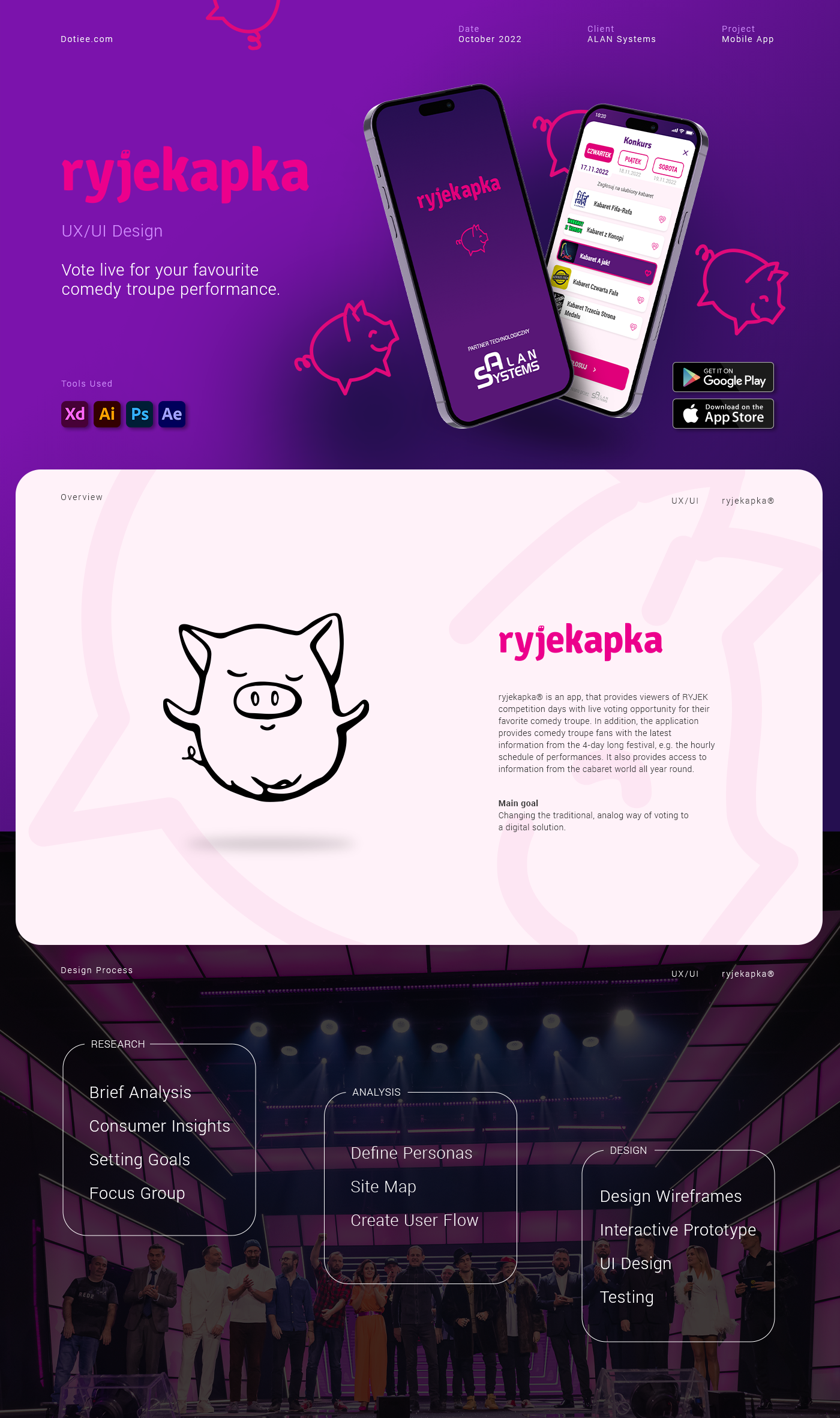
ryjekapka is a mobile application designed for real-time voting for favorite cabaret acts during the 4-day RYJEK (Rybnik Cabaret Autumn) festival. In addition to voting, the app provides the latest event news and a detailed hourly schedule.
PRIMARY OBJECTIVE:
The main goal was to introduce a modern approach to audience voting. For over 25 years, voting was conducted using analog methods (the volume and duration of applause). Since smartphones have become ubiquitous, the organizers decided to embrace digital innovation. ryjekapka was designed to:
The main goal was to introduce a modern approach to audience voting. For over 25 years, voting was conducted using analog methods (the volume and duration of applause). Since smartphones have become ubiquitous, the organizers decided to embrace digital innovation. ryjekapka was designed to:
- Enable fair and secure voting within a specific timeframe and location.
- Keep attendees informed about the schedule and RYJEK-related events.
- Serve as an additional advertising channel for festival sponsors.
The Discovery Phase: Aligning Needs & Goals
The initial phase of the Ryjekapka design process focused on defining the project scope and objectives. My role included:
User Needs Discovery: Identifying and understanding the core needs and pain points of the target audience.
Business Goal Alignment: Gaining a deep understanding of the product’s business objectives to ensure the design supports long-term strategy.
User Story Development & Analysis: Crafting and analyzing User Stories to map out functional requirements from the user's perspective.

Research & Discovery Challenges
Conducting standard user research proved challenging, as the design phase took place just two months before the cabaret festival. Consequently, the research was limited to targeted interviews with past festival attendees. My responsibilities included:
- Persona Development: Defining user personas based on insights gathered from rapid user interviews.
- Competitive Benchmarking: Analyzing similar applications to identify usability standards and innovative features.
- Technical & Security Consultation: Collaborating with developers to address technological constraints and evaluate voting security to prevent potential fraud or cyberattacks.
- User Flow Mapping: Developing comprehensive User Flows in Miro based on the collected data and security requirements.
UX Design
Based on the research findings, I moved into the UX design phase of the application. My core responsibilities involved:
- Designing Lo-Fi and Hi-Fi wireframes using Adobe XD.
- Interactive prototyping to define user flows and interactions.
- Facilitating workshops and stakeholder presentations to align on design goals.
- Refining prototypes based on client feedback and usability insights.
UI Design
Based on the gathered data and wireframes, I began working on the app's UI Design and prototype. The process consisted of the following stages:
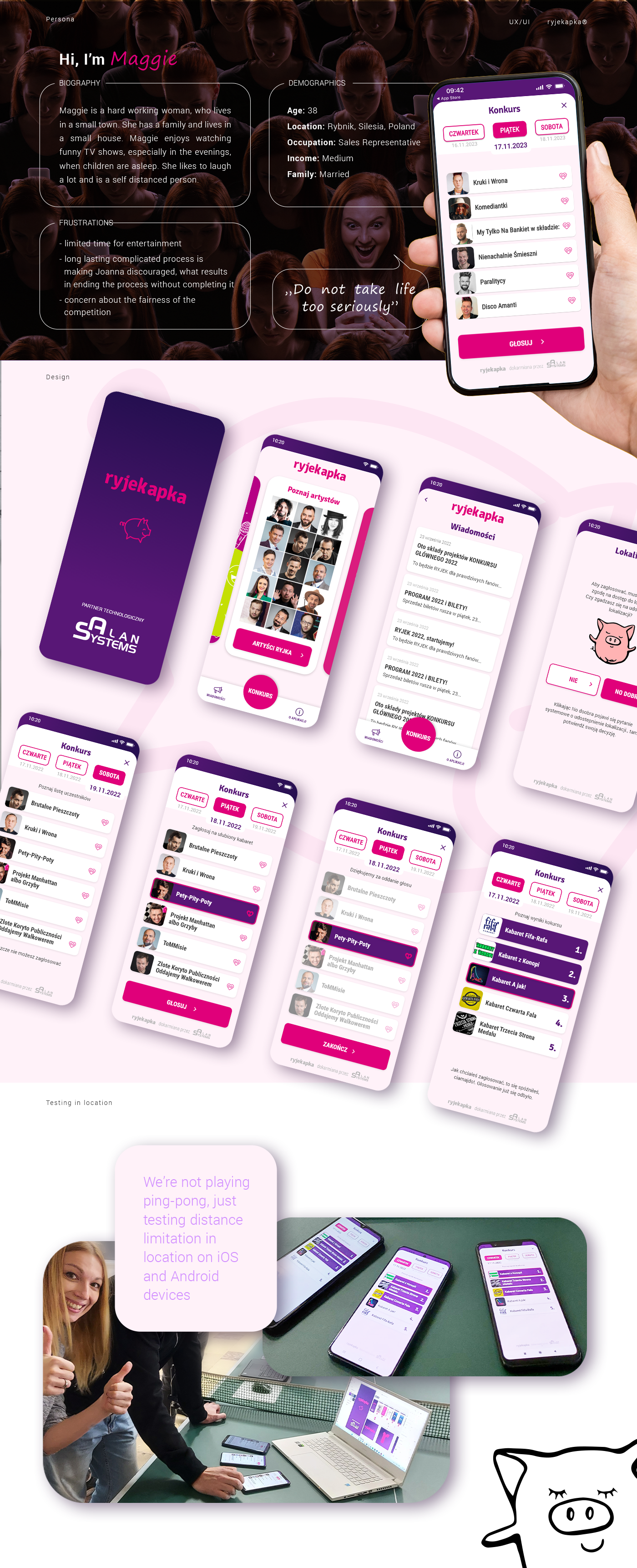
Aligning the visual style with the RYJEK logo and color palette. Since the product lacked a formal Corporate Identity (CI) beyond the logo itself and the recurring pig motif, I developed a palette consisting of magenta, various shades of pink, and purples. I also created a simple Design System that corresponds with the logo's aesthetics. I selected the typography and proposed the overall look and feel of the application.
Platform-specific design. The app was designed for two systems: Android (Google Material Design) and iOS (Apple Human Interface Guidelines). Consequently, individual interface elements were crafted to comply with the specific guidelines of both Google and Apple.
Optimization of the voting process. As voting was the most critical feature, the COMPETITION and VOTE Call To Action (CTA) buttons were strongly highlighted on every screen using a high-contrast color. Furthermore, to enhance usability, they were strategically placed within the natural reach of the right thumb.
Tests
The most intriguing aspect of the Ryjekapka project was the on-site location testing conducted at the cabaret competition venue.
The voting process itself is a brief window of activity lasting approximately 10 minutes. Upon the Organizer's signal, the administrator and developer would open the "voting gate" to collect entries, closing it immediately after the signal ending the vote.
To ensure the security and integrity of the competition, a specific geofenced area was defined (in meters). This zone covered the physical building and a small perimeter around it, restricting voting to those physically present.
At this stage, my primary objectives included:
- Testing the voting functionality on-site—both inside and outside the building.
- Verifying app performance across various Android and iOS devices.
Additional Graphic Assets
In addition to the UI design, I also created the following assets:
- App logo and favicon designed in Adobe Illustrator.
- App preloader (animated splash screen) created in Adobe After Effects.
- App Store and Google Play screenshots prepared in Adobe Photoshop.
Summary
The Ryjekapka project proved to be an incredible design and development challenge.
We successfully achieved the primary goal: migrating the voting process to a mobile application. Throughout each day of the festival, organizers encourage the audience from the stage to download the app. Through Ryjekapka, users can not only vote for their favorite cabaret but also access the event program and the latest news from the cabaret world.
Additionally, the app provided a new channel for sponsors to effectively promote their brands.
In all instances (the app was utilized across two editions of the RYJEK festival), the voting process was carried out without any technical issues. We also maintained high standards of security and integrity—the system prevented bot voting and submissions from unauthorized locations, further reinforced by the short, spontaneous voting windows.
Finally, some key statistics:
App Store: 4.6/5 rating (based on 64 ratings).
Google Play: 4.8/5 rating (based on 89 reviews) with over 500 downloads.
